Student Research Makes Meaningful, Real-World Impact
College of Charleston Honors student Saif Chaudhry has created a real-time AI scene narration app for people with visual impairment.
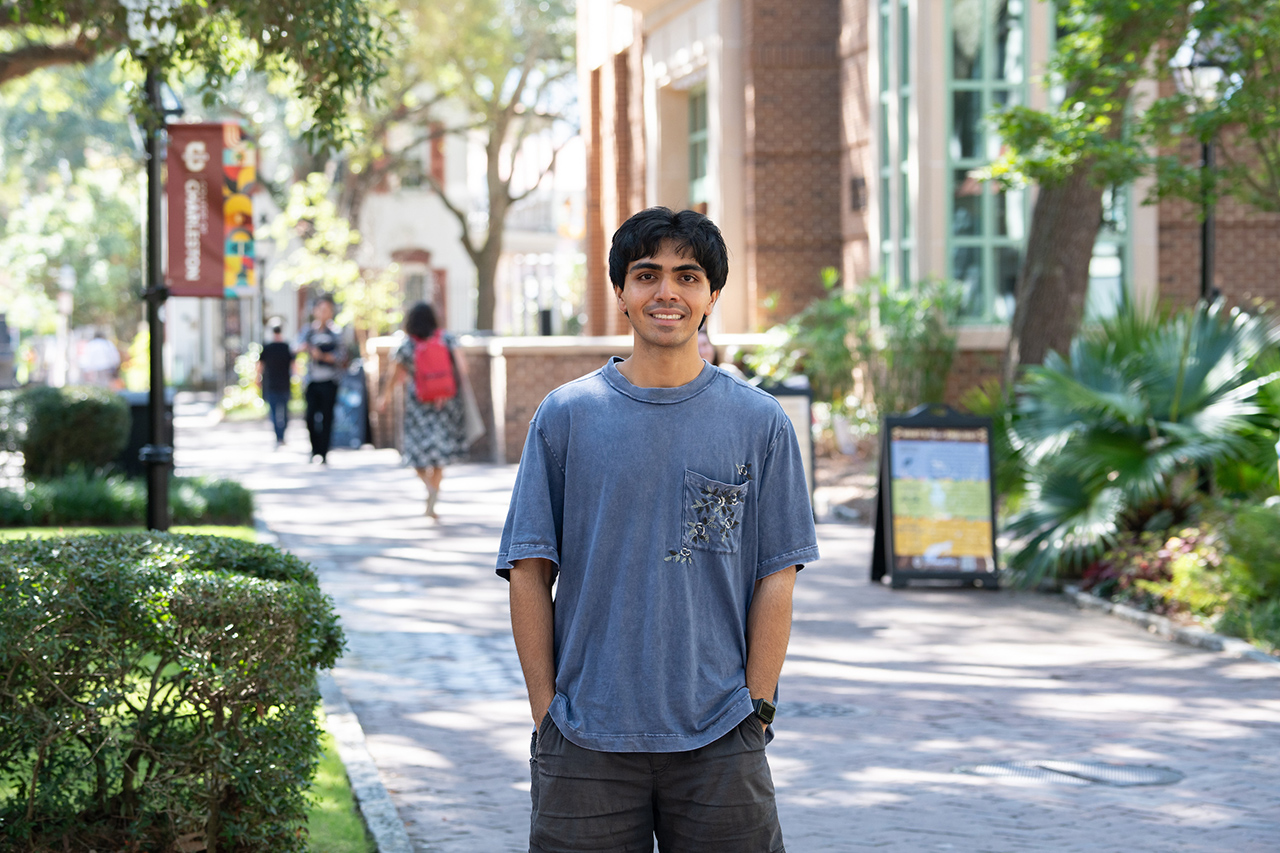
It’s easy to get lost in our world of rapidly developing technologies like AI, LLMs and other smart systems. But, the way Saif Chaudhry sees it, those technologies are what will help people navigate the world around them better.
Through his Summer Undergraduate Research with Faculty (SURF) project, titled, “Real-Time AI Scene Narration for People with Visual Impairments,” Chaudhry has created a mobile application that uses artificial intelligence to describe users’ surroundings in real time. Thus, for people with visual impairments, the world just got a whole lot more understandable.
“I wanted to work on this project because it is computationally difficult yet can still have an impact on someone’s daily life,” says the first-generation college student, explaining that, in his smart system, an iPhone 12 Mini captures video stream, sends it to a locally hosted AI model on a PC, and, within seconds, a naturally generated description of the scene is spoken aloud on the iPhone’s speakers. The resulting application identifies nearby people, vehicles, buildings, nature and so forth, communicating this information verbally to the user. In addition to live video, the application allows users to upload prerecorded footage, such as videos captured by a drone. “To me, the idea that simply combining a phone camera and AI could give someone with a visual impairment a way to understand their surroundings in real time feels very impactful to work on.”
Indeed, the research not only helps individuals with visual impairments to better understand their surroundings and makes technology more accessible, it also contributes to ongoing research in real-time camera visual systems.
The impact of Chaudhry’s SURF project isn’t lost on faculty mentor Mia Wang, assistant professor of computer science, who has been conducting research with the senior Honors student since his freshman year at the College.
“This work demonstrates how advanced AI models can be integrated into practical applications, with potential benefits for accessibility and human-computer interaction,” she says, adding that the complexity of the project is also impressive. “Saif’s research brings together several rapidly developing technologies, including artificial intelligence, machine learning, computer vision and large language models (LLMs). … I am very proud of what he has accomplished.”
Chaudhry is proud, too.
“I really enjoyed getting the entire end-to-end full pipeline system working,” he says. “I am proud that the system runs entirely offline with no cloud services needed, significantly decreasing privacy risks by keeping all data on the user’s local network. This system also does not rely on big data centers but rather a simple mid-tier PC that many people own, making the system more energy efficient and environmentally friendly.”
Since the summer project, Chaudhry has expanded the system to include a Duckietown robotic car with a camera that feeds into the same narration system.
“The goal is to have this robotic car drive autonomously around a mini road track while describing what it sees,” he says, noting that he will continue this research as part of his bachelor’s essay for the Honors College and Department of Computer Science. He has also submitted a research paper to the 2027 International Conference on Computer Vision Theory and Applications (VISAPP).
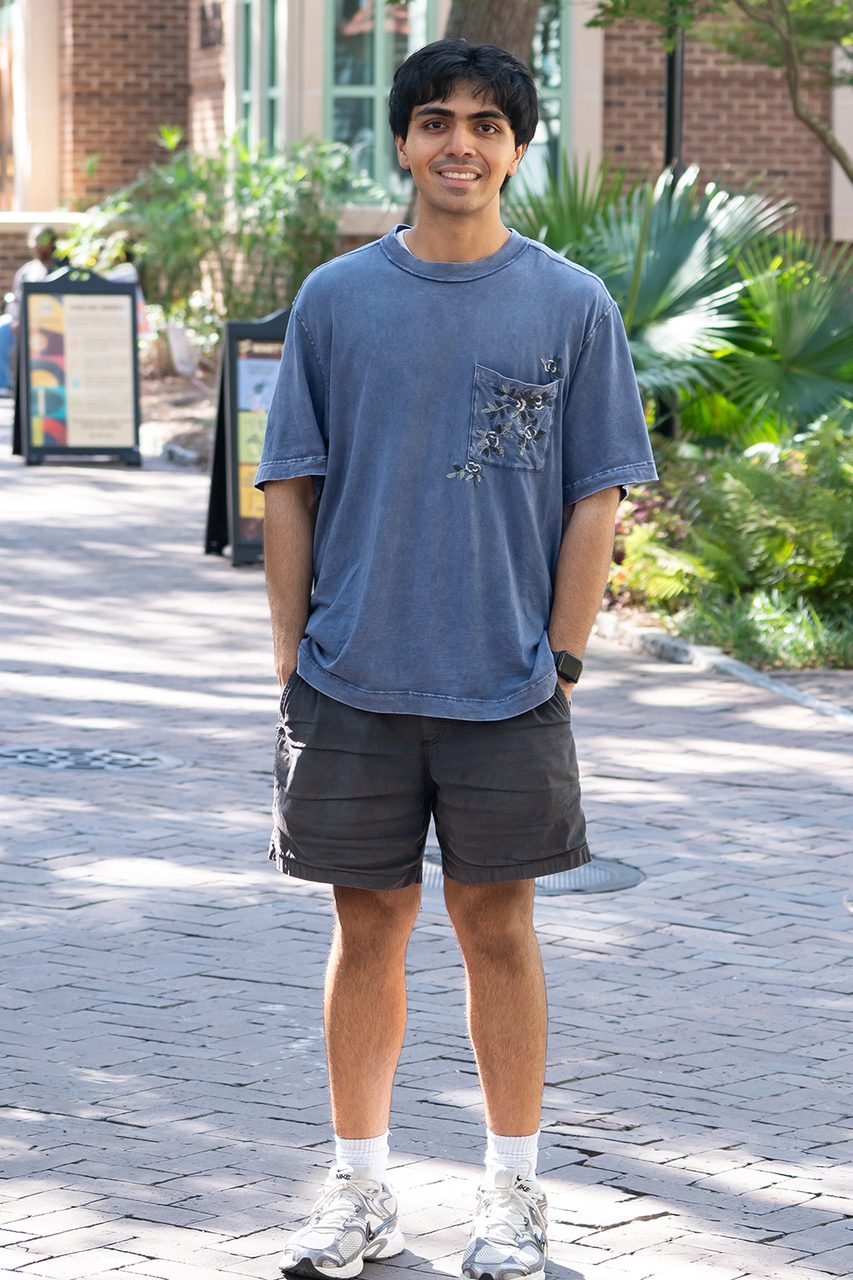
Research like Chaudhry’s has a meaningful impact not just in daily life for people or in future research: It has benefits for the student-researchers, too.
“Students benefit tremendously from hands-on research experiences that allow them to apply classroom knowledge to real-world problems,” says Wang. “These experiences help students develop critical thinking, problem-solving and independent learning skills.
“I always encourage my students to explore research topics that genuinely interest them because curiosity and passion are essential to meaningful research,” she adds. “More importantly, undergraduate research bridges the gap between coursework and future careers, giving students opportunities to explore what they enjoy and discover what they are capable of achieving.”
And, considering that Chaudhry has also interned in the automation department of Thermo Fisher Scientific for two summers, and “has experience working with hardware platforms, including drones, robotic vehicles and various sensors,” she says, he is capable of achieving great things after he graduates in May 2027.
“His ability to combine software and hardware technologies provides a strong foundation for future research in intelligent and autonomous systems,” she says, noting that Chaudhry has served as a tutor in the computer science department for several semesters, too. “Over time, he has grown from a student-researcher into someone I consider a research collaborator. He is highly productive, takes initiative and consistently challenges himself to learn new things.”
And – with plans to work full time in the computer science field while working toward his master’s degree – Chaudhry will certainly continue to learn new things, helping us all navigate our ever-changing world along the way.