Computer Science Instructor Has Students on the Right Course
The final projects in Anurag Tiwari’s upper-level AI course turn student-built AI tools into hiring assets.
How do you teach students about the rapidly evolving world of AI? Why, you look to ancient Greece, of course.
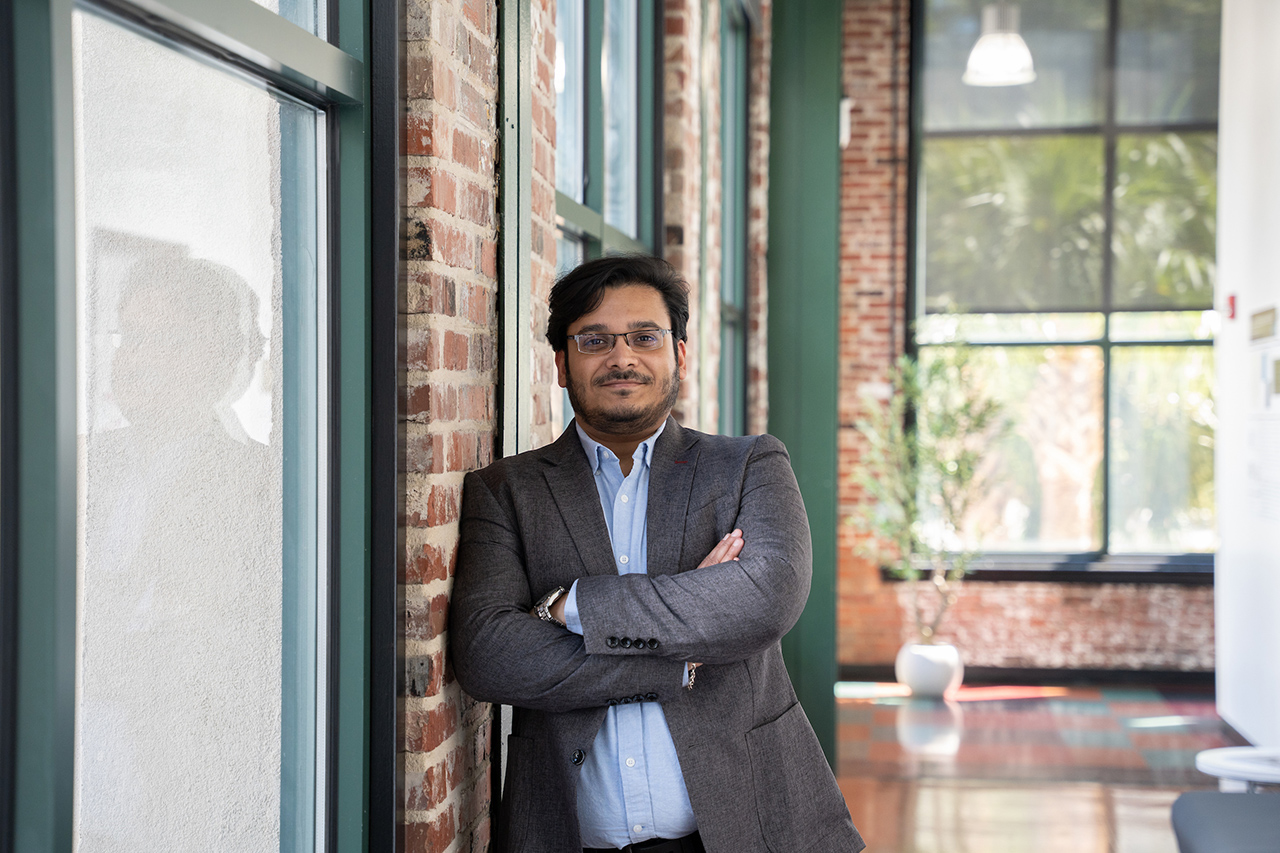
At least that’s what Anurag Tiwari, instructor of computer science at the College of Charleston, does in the introductory JAVA and two AI courses he teaches.
In his introductory “why” course, Tiwari verifies learning with technical and theoretical checkpoints on locked computers (no Internet access) in class to make sure students aren’t using AI as a crutch. In his “what” and “how” AI courses – where implementation and pragmatics matter – he leans the other way.
“They have full reign of using AI,” he says. “I try to teach my students: ‘Use it this way, not this way. Give it these guidelines.’”
The Greek intellectual progression — why, what, how — is deliberate: Master the motivation without shortcuts, then wield the tools – tools that caught the eyes of potential employers during the interview process. The upper-level CSCI 470 is mostly a theoretical deep dive into the logic and design of traditional AI, except for the final project, the goal of which is create a deployable learning system from scratch.
Last spring semester, students spun up an AI concierge for Charleston, a color palette generator, document-aware chatbots and more — not as toy demos, but as coherent products with defined users, constraints and evaluation plans. The requirement is consistent: Take an existing tool or framework, “wrap it around your problem” and create something usable.
From Usable to Useful
Data science major Cody Paquette ’26 created something not just usable, but something that proved useful for landing a job, too.
The rules judge he built for the collectible card game Magic: The Gathering is a guardrailed AI system that adjudicates the game’s labyrinthine rules to keep players from arguing with one another.
By the end of the semester, Paquette had a working tool, a documented GitHub repository showing end-to-end decision-making and a job offer at the Naval Information Warfare Center in North Charleston.
“Employers can see that this was not a traditional class project,” Tiwari says. “This was something they were passionate about, taken from inception and planning all the way to something that’s deployable, close to production ready.”
Digital Storytelling that Inspires Students, Employers
His fellow computer science instructor Lancie Affonso ’96 (M.S. ’08) calls Tiwari “the human in the loop” who uses digital storytelling to inspire his students.
“In the Age of AI, we are fortunate to have extraordinary instructors at the College like Anurag who combine industry experience with an intentional focus on human creativity,” says Affonso, an Honors College faculty fellow who also serves as the director of the Honors College Entrepreneurship Living-Learning Community and as a senior instructor of management and marketing.
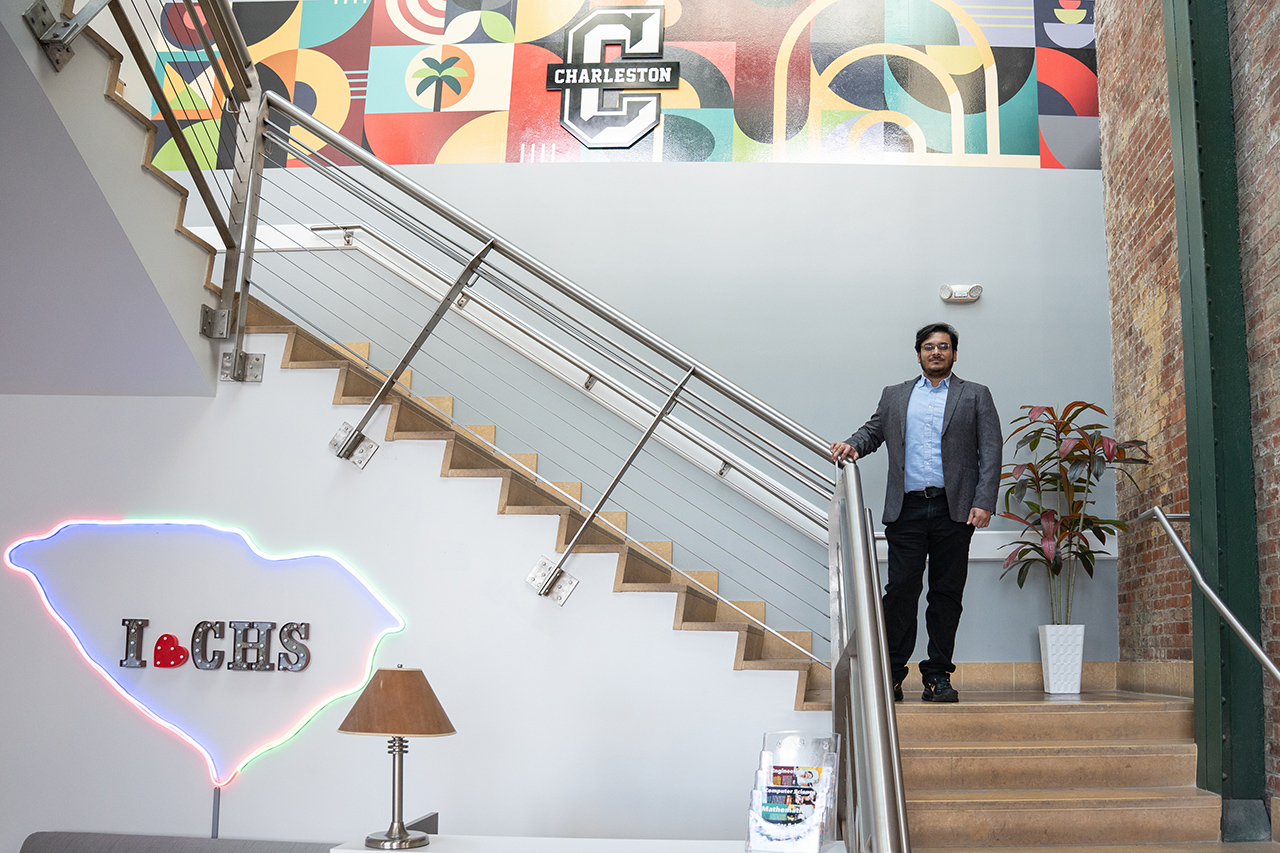
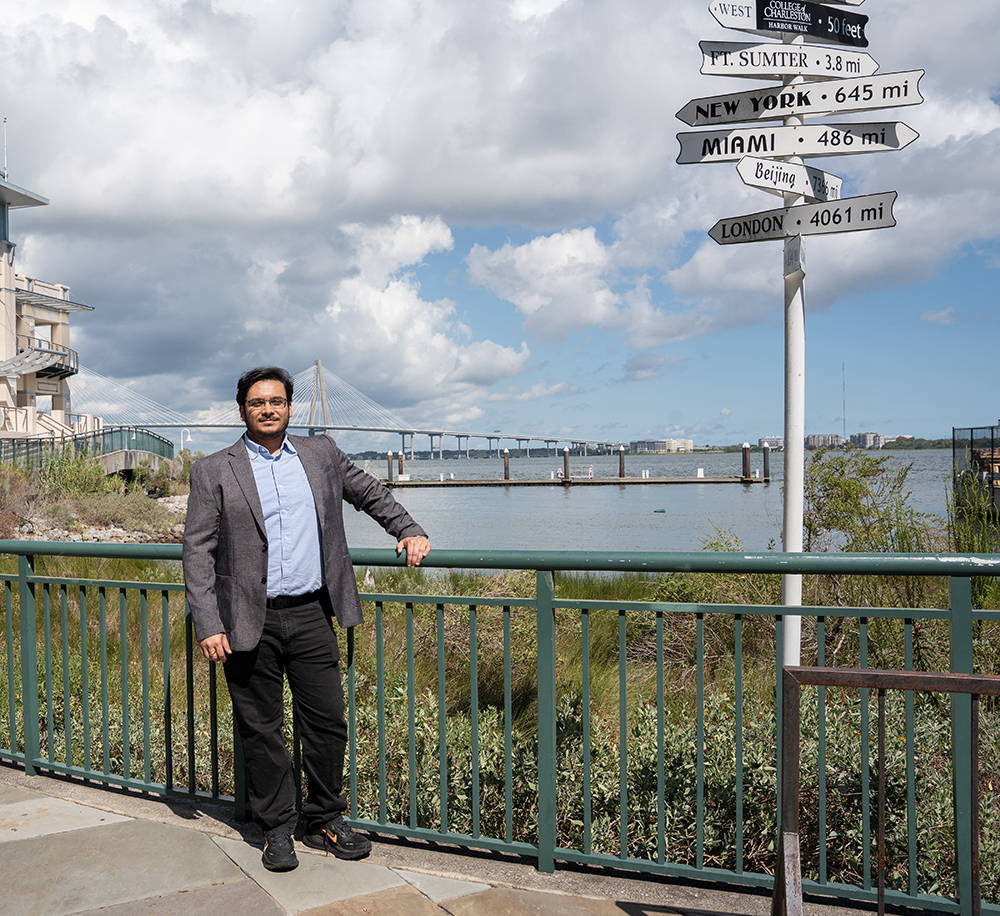
Raised in India, Tiwari started his career as a game developer in Los Angeles after earning a master’s in computer science from the University of Southern California in 2017. He came to Charleston in 2018 to work for a Moondog Animation Studio to create interactive games. His boss, Ben Davis, was on the Industrial Advisory Board of the College of Charleston Department of Computer Science, which lead to Tiwari joining the the department two years ago.
“Anurag has been a great addition to the department,” says Renée McCauley, chair of the department. “Part of our mission, beyond making sure graduates leave with both theory and technical skills to ensure success, is to help students make the next move, whether that be to industry or to graduate study.
“The majority of our students are industry focused, so helping them connect with employers is important,” she continues. “After encouraging students to provide links to their projects on their résumés, Professor Tiwari has discovered from students that industry interviewers have mentioned having taken notice of them after viewing their (AI) projects.”
Artificial Intelligence vs. Human Creativity

So, how does Tiwari use AI in his own life? He likes to use Qwen and Kimi to assist him with classwork and poke holes in assignments. Although he runs them locally on his computer so he doesn’t “have to send the AI overlords my data,” he’s not an AI doomsayer by any means.
“While these models can do really well with scientific or mathematical reasoning, they really struggle with creativity,” he says. “It’s very difficult for them to come up with something new because their architecture dictates they find permutations of past data.
“My professor, Mike Zyda at USC, used to say, ‘Humans are raised, not programmed, so you cannot replicate that human level of intelligence and reasoning,’” Tiwari recalls. “It’s getting close, but that last 10% is what makes us human.”