2 Students, 1 Goal: Supporting Spinal Stenosis Research
For two College of Charleston biology majors, SURF grants and the SC INBRE program made it possible to advance not just medical research, but their medical careers, as well.
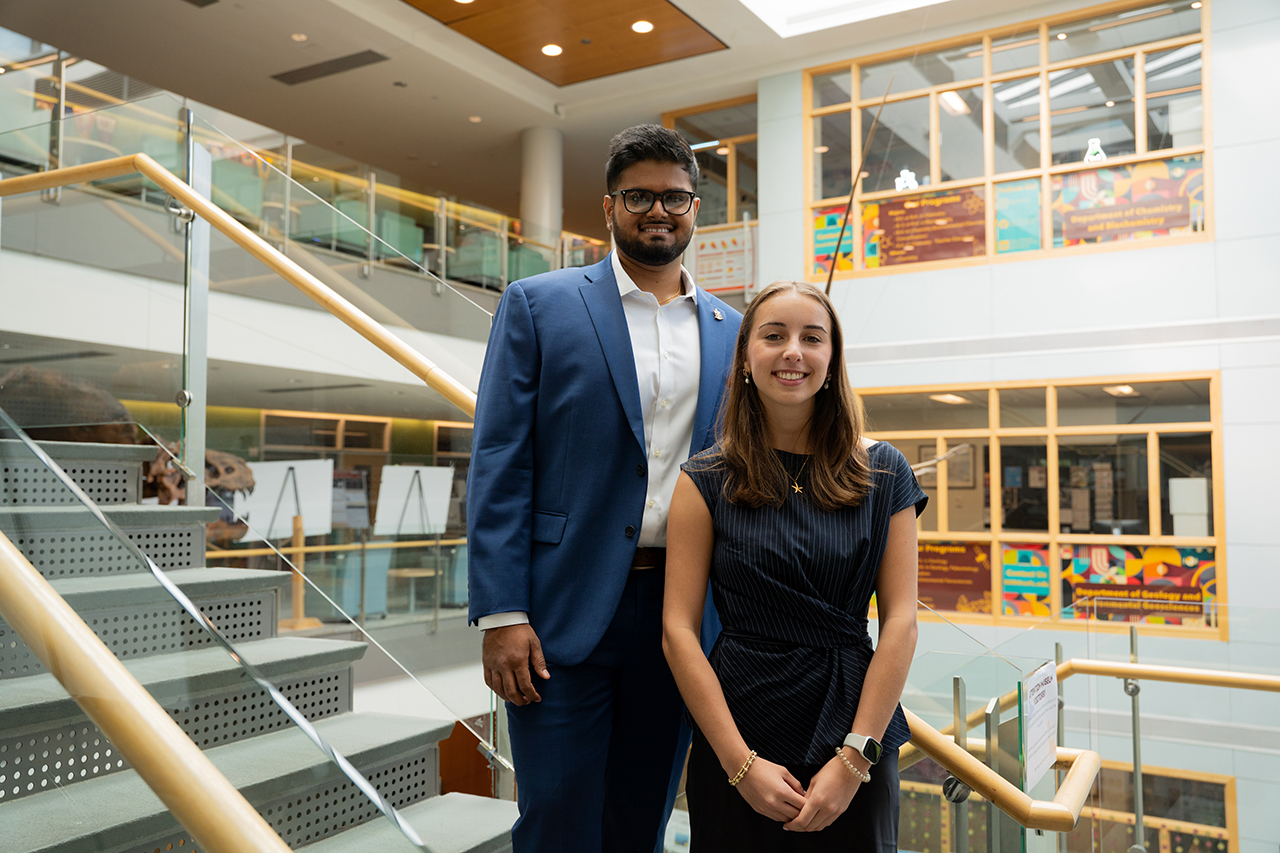
Above: Kartik Valluri and Alexa Jones (photos by Abby Albright)
Last summer, two rising juniors in the College of Charleston Honors College suited up in lab coats to test spinal tissue samples at the Medical University of South Carolina (MUSC).
Thanks to Summer Undergraduate Research with Faculty (SURF), an immersive 10-to-12 week summer research experience that pairs students with a faculty mentor, biology majors Kartik Valluri and Alexa Jones worked to tackle a real-world scientific question: What is the relationship between amyloid deposition and ligamentum flavum hypertrophy in the spine?
If that sounds intimidating, their mentor, Sarah Porto, assistant professor of exercise science education and lead of the research, breaks it down: Simply put, the team is studying how protein buildup (amyloids) causes a spinal ligament to harden and thicken over time, which causes pain and loss of mobility primarily in older adults.
Advancing Research
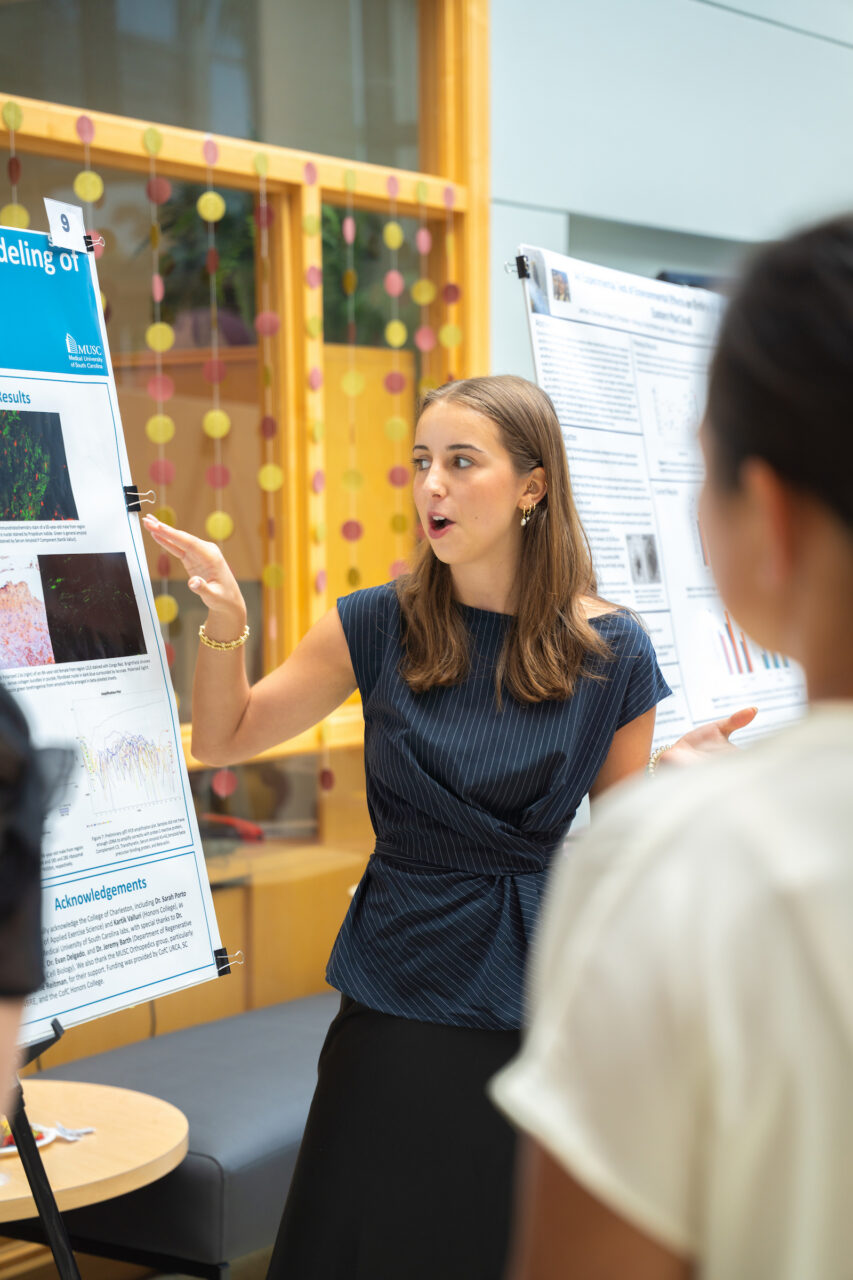
As an aspiring orthopedic surgeon, Valluri jumped on the opportunity to join Porto’s orthopedics-based lab. While he admits it was challenging at first to grasp the scientific complexity, he credits Porto for making it a learning experience.
“It’s a very constructive environment where you can make mistakes, and she’ll guide you through that,” he says.
After receiving and cleaning tissue samples from the orthopedics department, Valluri worked to quantify the amount of amyloid (plaque) deposition within the ligamentum flavum. Through this research, he’s been able to introduce a key idea: amyloid deposition increases in the ligamentum flavum with age.
He believes this technique will be valuable for researchers moving forward.
Jones, who also has her eyes set on attending medical school, was eager to take what she knew from previous DNA research and apply it to extracting RNA from spinal tissue.
Using this tedious process, Jones has navigated the trial-and-error that comes with extracting RNA from spinal tissue samples. Her goal is to isolate specific genes and determine whether their expression changes in relation to amyloid buildup.
Advancing Careers
For two hopeful future doctors, few experiences are more exciting than working in the No. 1 hospital in South Carolina, MUSC.
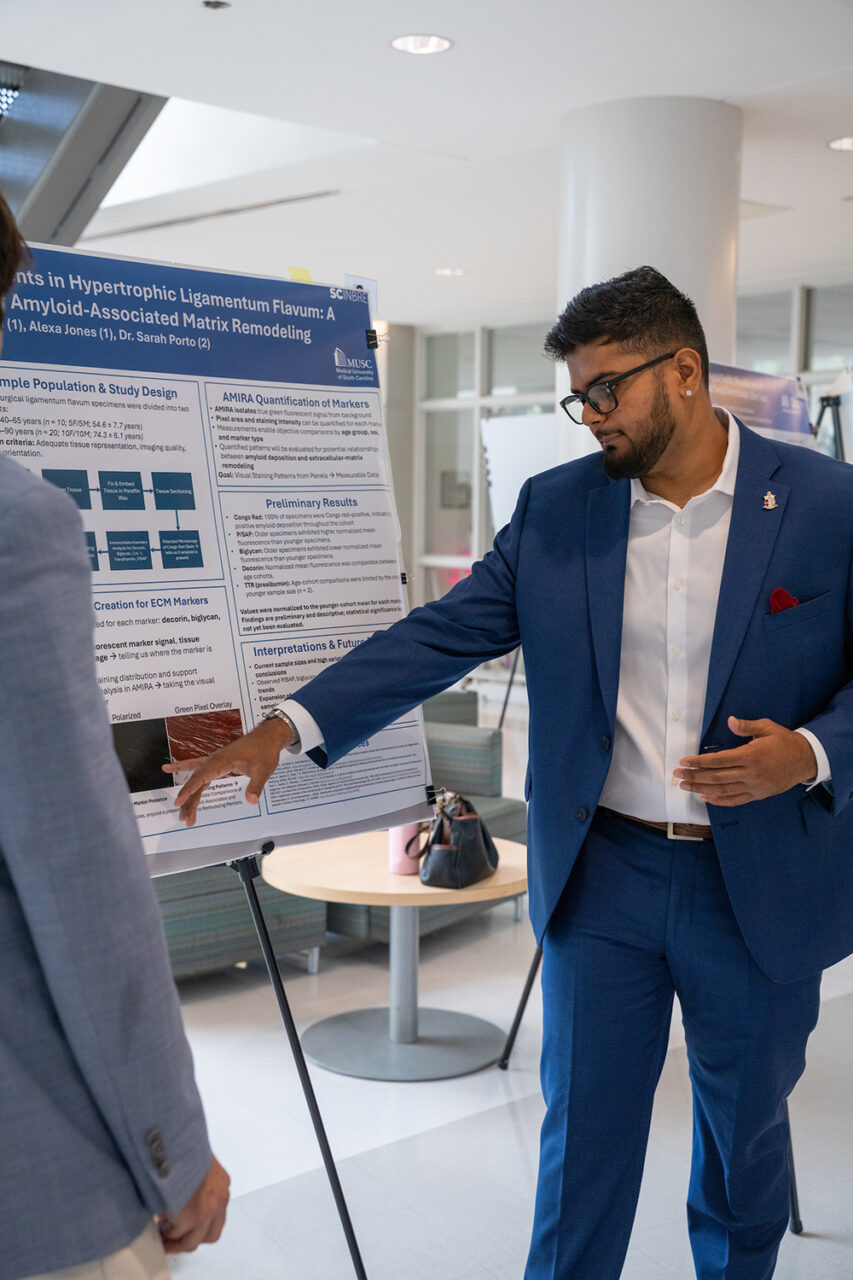
Through the SC INBRE program (South Carolina IDeA Network of Biomedical Research Excellence), College of Charleston partners with MUSC to provide students and faculty the funding and resources for cutting-edge biomedical research. With the support of INBRE, the research was hosted and managed in MUSC’s labs, giving the team access to state-of-the art equipment and the opportunity to collaborate with doctors and scientists.
Valluri and Jones have taken full advantage of being in MUSC’s immersive learning environment. In addition to working on their own research, they’ve also met medical students, shadowed doctors and visited neighboring labs; noting that everyone is very open to talking to undergraduate students.
“It’s been excellent,” Valluri says. “I love being able to go over to MUSC and just be in the midst of people in that setting, whether it be med students or doctors who are already there.”
Although the SURF session has concluded, Porto shares that the project is far from over. Their data has answered many important questions, but there is more to uncover about amyloid behavior in ligamentum flavum tissue.
As time allows with their busy schedules, Valluri and Jones will keep collecting important data. Porto is grateful for their contributions, emphasizing that “without them, it wouldn’t be where it’s at today.”
For students looking to get involved in scientific opportunities like these, Valluri and Jones happen to echo every professor’s favorite line: “Check your email!”
Between funded programs like SURF, URCA and the Honor’s College grants, there’s endless opportunities waiting for students to take advantage of.
As Jones puts it, “If you don’t take it, somebody else will.”