Inside the College of Charleston Observatory
Through classroom instruction, hands-on research and public outreach, the College of Charleston observatory inspires the next generation of astronomers.
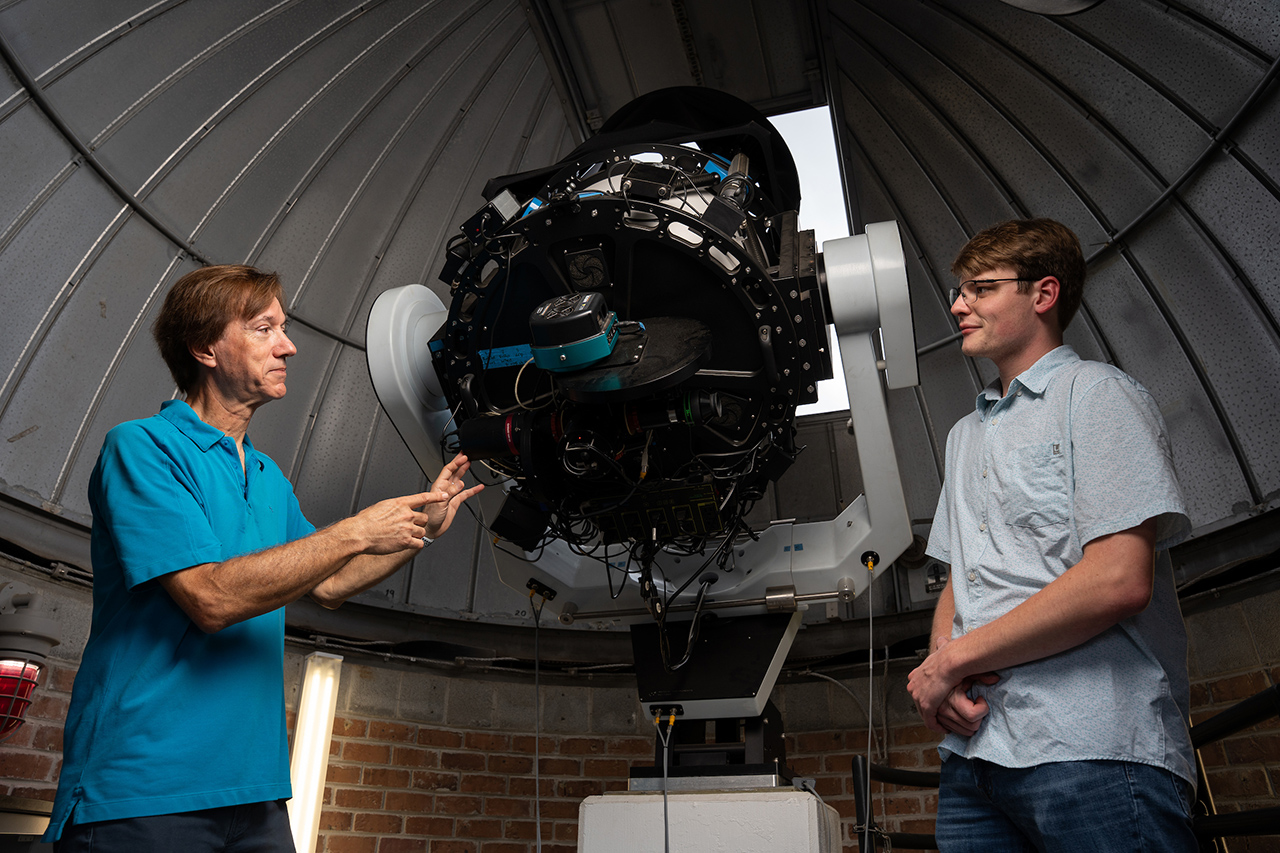
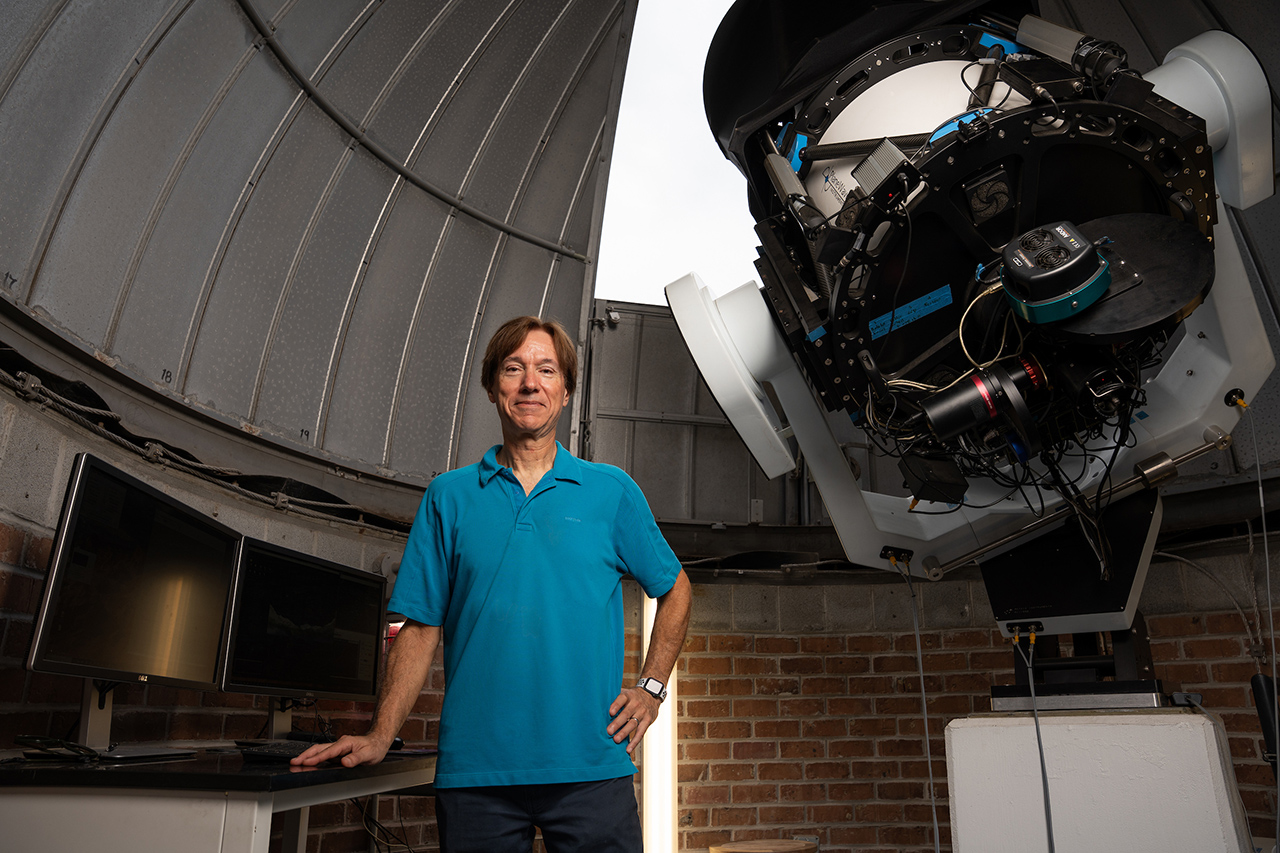
Above: George Chartas with junior physics major Zachary Premak (Photos by Catie Cleveland)
Students at the College of Charleston are gaining hands-on astronomy experience from a high-powered telescope located near the heart of campus. The telescope is one of the largest of its kind in South Carolina. Just off the Cistern Yard, perched atop the Rita Liddy Hollings Science Center, the observatory offers students valuable opportunities to learn and conduct astronomical research while providing the Charleston community with the chance to explore the night sky during monthly public events.
As part of renovations to the science center in 2018, the College upgraded the observatory with a PlaneWave Instruments CDK (Corrected Dall-Kirkham) 24-inch telescope. This advanced instrument is equipped with a large mirror and exceptional image quality, allowing astronomers to collect more light and observe fainter, more distant objects, including bright galaxies hundreds of millions of light-years from Earth and luminous quasars billions of light-years away. Having cutting-edge scientific equipment on campus means students don’t need to travel to off-site research facilities to gain practical, job-ready experience.
George Chartas, observatory director and an astrophysicist in the College of Charleston Department of Physics and Astronomy, teaches experimental astronomy, where students learn to operate the telescope and analyze the observational data they collect themselves.
“Understanding how the telescope works, capturing high-quality images of celestial objects and analyzing the data they collect helps prepare students for graduate studies and future careers in astronomy,” says Chartas.
From nearby objects in our solar system to galaxies millions of light-years away, College of Charleston students have access to one of the most impressive telescopes in South Carolina.
Bright Stars Among Us
Current student research in astronomy spans a wide range of topics, from monitoring asteroids to observing planets orbiting stars beyond our solar system. One of Chartas’ students is studying exoplanet transits, which are tiny dips in a star’s brightness that occur when a planet passes in front of it. By measuring these changes in light, students can calculate the size of distant planets and gain experience with current best practices in scientific discovery.
Chartas has seen many students graduate from the College and pursue astronomy as a profession.
“A lot of them decide this is what they want to do once they actually start collecting data on their own,” he says, adding that one former student went on to the University of Hawaii, where he operated the 10-meter W. M. Keck Observatory telescope, one of the world’s largest optical telescopes. The student later told Chartas that the hands-on training he received at the College was invaluable in preparing him for that opportunity.
The observatory is not only a research facility for faculty and students but also a place where science becomes accessible to the broader community. Once a month during the academic year, the observatory hosts free open houses for the Charleston community. During these events, visitors can view the Moon, planets, colorful nebulae, star clusters and distant galaxies through the observatory’s 24-inch research telescope and several smaller telescopes operated by students. Faculty members, including Chartas and fellow astronomy professor Laura Penny, are on hand to explain what guests are seeing and answer questions.
While the observatory enables students to study celestial objects ranging from nearby planets to galaxies hundreds of millions of light-years away, its greatest impact is much closer to home. By combining classroom instruction, hands-on research and public outreach, the College of Charleston observatory inspires the next generation of astronomers and invites the Charleston community to share in the wonder of the universe.