Genealogy Search Links Ohio Man to the College of Charleston
A genealogy search brought Fred Kerner to the College of Charleston campus to visit 14 Green Way, which was built for his great-grandfather in 1872.
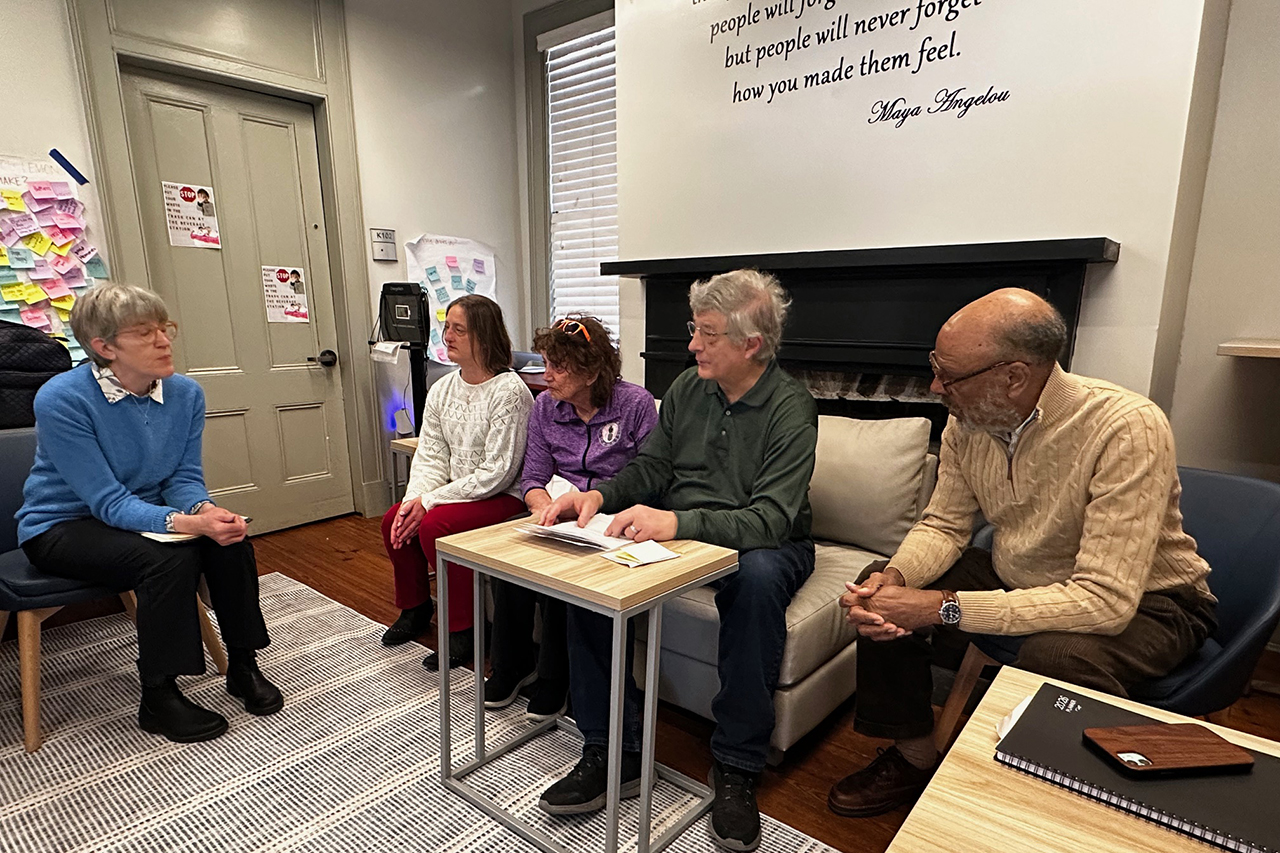
Video Image Above (l–r): Aaisha Haykal (manager of archival services in the Avery Research Center), Bernard Powers, Julia Eichelberger, Julie Kerner, Joy Kerner, Fred Kerner, President Andrew T. Hsu
As a child, Fred Kerner’s maternal grandparents lived in his childhood home in Dundalk, Maryland, in an upstairs bedroom. However, because his father and grandfather didn’t get along, Kerner’s grandparents largely kept to themselves.
“I don’t remember talking to my grandfather a lot when I was younger,” Kerner says.
It wasn’t until he was older that his unanswered curiosity about his family grew stronger. His wife, Joy, has a close friend who researches genealogy and helped compile information from both the paternal and maternal sides of his family.
Kerner also had a family relic that his now-deceased sister gave to him – a leather-bound diary belonging to their maternal great-grandfather. “I guess I was just going to borrow it, but I ended up not giving it back to her,” he says. “I just forgot about it, actually.”
Kerner and his wife eventually took the diary to a library in Beaufort, South Carolina, to interpret the intricate cursive writing. The visit revealed his great-grandfather’s name, along with copies of a real estate deed, though much of the diary remained undeciphered.
Digging Into the Past

Back home, a visit to a library in Columbus, Ohio, pushed his search even further using a genealogy database. With new information in hand, Kerner continued digging. What began as a single, unexpected label in a record open the door to something far more revealing.
“I saw my grandmother and my grandfather’s name, Albert Victor Jones, and he was listed as ‘mulatto,’” says Kerner. The term, once commonly used in census records to describe a person of mixed Black and white ancestry, revealed a part of his family’s racial history he had never known. The discovery ultimately led him to the College of Charleston and 14 Green Way, a house on campus.
The 14 Green Way house was built in 1872 for Albert Osceola “A.O.” Jones, a light-skinned African American. Originally from Washington, D.C., Jones moved to South Carolina after the Civil War and became involved in politics during the Reconstruction Era when Black men first received the right to vote and hold office. He served as clerk of the South Carolina House of Representatives from 1868-1876.
The deeper Kerner dug, the clearer the lineage became – and with it, the identity behind the diary’s author. A.O. Jones was indeed the father of Kerner’s grandfather, Albert Victor Jones – and the owner of the diary!
“I wish I knew all this then because I was kind of unaware of my grandfather’s family and background,” says Kerner.
Bringing Today to Light
Kerner and his wife didn’t want the story to end with a genealogy search. Their daughter, Julie, who lives in Charleston, was visiting the College’s campus when she came across the home at 14 Green Way.
Through the generosity of a College donor, the Committee on Commemoration and Landscapes held a ceremony in May 2024 and placed a bronze sign at the entrance of the property outlining the history of Jones and the home.
After confirming the information on the historical marker, Kerner and his wife decided to travel to Charleston to see it for themselves.
During the visit, the Kerners heard documented stories about A.O. Jones from Julia Eichelberger, English professor and chair of the Committee on Commemoration and Landscapes, and Bernard Powers, director of the College’s Center for the Study of Slavery in Charleston and professor emeritus of history.
They also visited Special Collections in the Marlene and Nathan Addlestone Library to view letters written by Jones, as well as the Family History Center at the International African American Museum in Charleston, which is now scanning and transcribing the diary for the Kerner family and future researchers.
“The story of A. O. Jones, like the story of Reconstruction after the Civil War, was almost forgotten. Students’ research helped us to recover a fuller story of a house built during that hopeful moment in time,” says Eichelberger. “Through the Jones family’s beautifully preserved house, students can experience part of their story. Now the Kerner family’s visit shows us that their story is continuing in the present.”

Shaping the Future
The College purchased the 14 Green Way property in the 1960s. Initially, the College rented the property to the Junior League of Charleston, which used the space as a home for troubled children. After renovations in 1972-73, the College converted the property into a women’s dormitory.
Most recently, it was the home of the Office of Multicultural Student Programs and Services and in 2025 was transformed into the Life Design Center. The College of Charleston is one of the first universities in the Southeast to offer a campuswide Life Design program, inspired by Stanford University’s groundbreaking Designing Your Life framework.
Although Kerner didn’t have a vast knowledge of his great-grandfather, his family’s visit to the patriarch’s home left him feeling reflective about how the home is now serving the students at the College.
“Get as much education as you can. Learn as much as you can,” he says. “I think that’s what my great-grandfather would say if he were alive today. I believe he would be proud to see what his home has become and how it’s helping shape students’ futures.”